
New Mexico Signal Design Manual: A Comprehensive Article Plan (as of 03/30/2026 16:38:04)
Standard Specifications detail crucial requirements for traffic signal projects within New Mexico, ensuring uniformity and adherence to established engineering practices.
This manual serves as the definitive guide for all traffic signal design, installation, and maintenance activities throughout the state of New Mexico. It consolidates best practices, regulatory requirements, and technical specifications into a single, accessible resource. Developed by the New Mexico Department of Transportation (NMDOT), it aims to enhance safety, optimize traffic flow, and promote consistency across all signalized intersections. The manual’s comprehensive approach benefits engineers, technicians, and contractors involved in traffic signal projects, fostering a standardized and efficient process.
Purpose and Scope of the Manual
The primary purpose of this New Mexico Signal Design Manual is to establish uniform standards for traffic signal systems. Its scope encompasses all phases of signalization – from initial warrant studies and design, through construction and acceptance testing, to ongoing maintenance. This includes detailed guidance on signal timing, hardware specifications, and safety protocols. The manual applies to all publicly funded traffic signal projects within New Mexico, ensuring consistent application of engineering principles and regulatory compliance.
Applicable Standards and Codes
This manual incorporates several key standards and codes governing traffic signal design in New Mexico. These include the latest edition of the Manual on Uniform Traffic Control Devices (MUTCD), New Mexico Statutes Annotated (NMSA) pertaining to traffic control, and guidelines from the American Association of State Highway and Transportation Officials (AASHTO). Additionally, relevant National Electrical Code (NEC) provisions and industry best practices are integrated to ensure safe and reliable signal system operation.
MUTCD Compliance
Strict adherence to the Manual on Uniform Traffic Control Devices (MUTCD) is paramount in all New Mexico signal designs. This ensures consistency and national interoperability of traffic control measures. The manual details specific requirements for signal phasing, timing, and display characteristics. All designs must reflect the current MUTCD edition, including provisions for pedestrian and bicycle safety, and accessibility standards, guaranteeing public understanding and safety.

NMSA Requirements
New Mexico Statutes (NMSA) establish the legal framework for traffic control and signalization within the state. These statutes dictate authority, responsibilities, and specific regulations governing signal installation and operation. Compliance with relevant NMSA sections is mandatory for all projects, covering aspects like permitting, right-of-way acquisition, and liability. Designers must demonstrate thorough understanding and incorporation of these legal mandates throughout the signal design process.
AASHTO Guidelines
The American Association of State Highway and Transportation Officials (AASHTO) provides nationally recognized guidelines for roadway design, including traffic signals. These guidelines offer best practices for geometric design, materials selection, and safety considerations. While not legally binding like NMSA, AASHTO recommendations significantly influence New Mexico’s signal design standards. Adopting AASHTO principles promotes consistency, enhances safety, and facilitates interoperability across state lines.
Signal Timing Fundamentals
Effective signal timing is crucial for optimizing traffic flow and minimizing delays. Key concepts include cycle length, phase sequencing, and split timing. Cycle length determines the total time for all signal phases. Phase sequencing dictates the order in which movements receive the right-of-way. Split timing allocates the duration of each phase. Proper timing balances competing demands, reduces congestion, and improves overall intersection efficiency.
Cycle Length Determination
Determining optimal cycle length involves balancing opposing needs: minimizing delay versus reducing the number of stops. Shorter cycles favor pedestrian movements and side street traffic, while longer cycles benefit through movements. Calculations consider critical lane volumes, pedestrian crossing times, and intersection geometry. New Mexico guidelines emphasize a systematic approach, utilizing software tools and field observations to establish appropriate cycle lengths for varying traffic conditions.
Phase Sequencing and Split
Phase sequencing dictates the order in which traffic movements receive the right-of-way, prioritizing safety and efficiency. Split timing allocates green time to each phase based on traffic demand. New Mexico prioritizes leading left-turn phasing where warranted, minimizing conflicts. Proper sequencing avoids permissive-only left turns on high-speed roadways. Optimization considers pedestrian volumes and coordination with adjacent signals, ensuring smooth traffic flow and reduced congestion.
Coordination with Adjacent Signals
Coordination between signals minimizes stops and maximizes progression along arterial routes. New Mexico emphasizes system-wide coordination plans, utilizing time-based or actuated coordination. Effective coordination requires careful analysis of traffic patterns and signal timings. Offsets are crucial for creating a “green wave,” reducing delays. Communication between controllers, often via fiber optic cable, enables real-time adjustments and adaptive timing strategies for optimal flow.
Signal Head Design and Placement
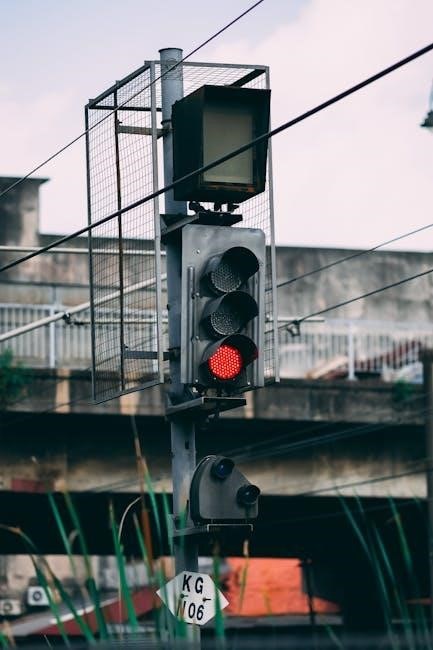
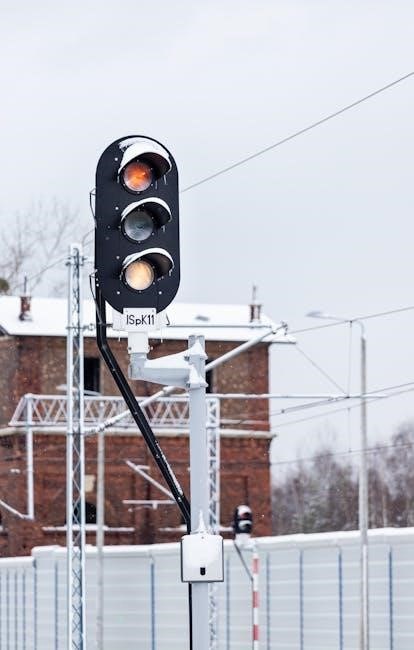
Signal head design in New Mexico prioritizes visibility and driver recognition. Placement adheres to strict geometric guidelines, ensuring clear sight lines and minimizing glare. Configurations include mast arm, pole-mounted, and pedestrian signals. Lens reflectivity and backplate specifications enhance conspicuity. Horizontal and vertical angles are carefully calculated based on approach speeds and intersection geometry, maximizing safety and efficiency for all road users.
Signal Head Types (12″, 15″, 20″)
New Mexico’s manual specifies signal head sizes – 12″, 15″, and 20″ – based on intersection complexity and approach speeds. 12″ heads suit lower-speed, simple intersections. 15″ provides enhanced visibility for moderate conditions. 20″ heads are mandated for high-speed roadways and complex intersections, ensuring optimal driver recognition and response times. LED technology is standard across all sizes, improving energy efficiency and lifespan.
Backplate and Visor Specifications
New Mexico mandates specific backplate and visor requirements to maximize signal visibility and minimize glare. Backplates must be retroreflective gray, enhancing contrast during daylight and adverse weather. Visors are required above each signal section, reducing sun glare and improving nighttime legibility. Materials must meet MUTCD standards for reflectivity and durability, ensuring long-term performance and driver safety at signalized intersections.
Mast Arm and Pole Requirements
New Mexico’s signal design standards dictate robust mast arm and pole specifications. Structures must withstand regional wind loads and seismic activity, ensuring public safety. Mast arms require specific length-to-span ratios for optimal signal head placement. Poles necessitate galvanized steel or equivalent corrosion protection. Foundations must be engineered to support combined signal and wind loads, adhering to AASHTO guidelines for structural integrity.
Pedestrian Signals and Accessibility
New Mexico prioritizes pedestrian safety through compliant signal design. Accessible Pedestrian Signals (APS) are mandated at intersections with pedestrian crossings, featuring audible and vibrotactile elements. Pedestrian push buttons must meet ADA height and reach requirements. Timing plans incorporate sufficient WALK and flashing DON’T WALK intervals, accommodating diverse pedestrian walking speeds, ensuring inclusivity and safe crossings for all users.
Accessible Pedestrian Signals (APS)
New Mexico’s APS standards ensure inclusivity for visually impaired pedestrians. Systems utilize audible alerts, vibrotactile surfaces, and synchronized speech messages indicating crossing times. MUTCD guidelines dictate specific tone characteristics and volume levels. Proper placement and orientation of APS units are critical for effective communication. Regular maintenance and testing are essential to guarantee reliable operation and pedestrian safety at signalized intersections.
Pedestrian Push Buttons
New Mexico mandates specific requirements for pedestrian push button design and placement, prioritizing accessibility. Buttons must feature tactile arrows and contrasting colors for visibility. Mounting heights adhere to ADA standards, ensuring reachability for all users. Durable, weather-resistant materials are essential for longevity. Proper integration with the signal controller is crucial for accurate pedestrian phase activation and safe crossing intervals.
Timing for Pedestrian Crossings
New Mexico’s signal timing for pedestrian crossings prioritizes safety and compliance with accessibility guidelines. Walk and flashing don’t walk intervals must accommodate pedestrian walking speeds, considering potential delays. Minimum walk times are calculated based on street width and pedestrian characteristics. Coordination with adjacent signals prevents pedestrian conflicts. Proper timing ensures sufficient crossing time for all users, including those with disabilities.
Detection Systems
New Mexico utilizes various detection systems for efficient traffic signal control. Inductive loop detectors remain prevalent, sensing vehicle presence through electromagnetic fields. Video detection systems offer broader coverage and adaptability. Microwave radar detectors provide reliable detection in diverse weather conditions. Proper placement and calibration are crucial for accurate vehicle counts and optimized signal timing, enhancing traffic flow and safety.
Inductive Loop Detectors
Inductive loop detectors, embedded in the pavement, are a cornerstone of New Mexico’s traffic detection. These systems create a magnetic field, detecting metallic vehicles passing over them. Loop size and configuration impact accuracy; careful design is essential. Proper installation and regular maintenance are vital to counteract environmental factors and ensure reliable operation, contributing to responsive signal timing and reduced congestion.
Video Detection Systems

Video detection systems utilize cameras and image processing to monitor traffic flow in New Mexico. These systems offer flexibility, detecting vehicles, pedestrians, and bicycles without pavement intrusion. Camera placement and calibration are critical for accuracy, alongside considerations for lighting and weather conditions. Advanced algorithms classify traffic, enabling adaptive signal control and improved efficiency, though initial costs can be higher.
Microwave Radar Detectors
Microwave radar detectors employ radio waves to sense vehicle presence in New Mexico intersections. These non-intrusive sensors operate effectively in various weather conditions, offering reliable detection. Adjustable sensitivity and detection zones allow for tailored performance. While generally less expensive than video, they may have limitations in accurately classifying vehicle types, impacting advanced signal timing strategies. Proper mounting and aiming are essential.
Controller Specifications and Programming
Controller specifications within the New Mexico manual mandate NEMA standards for traffic signal controllers; Programming must adhere to strict guidelines, utilizing approved software and firmware versions. Conflict monitoring features are crucial for safety. Controllers require sufficient memory and processing power for complex timing plans. Redundancy and backup systems are recommended. Detailed logging capabilities aid in troubleshooting and performance analysis, ensuring optimal signal operation.

Controller Cabinet Requirements
Controller cabinets, as per the New Mexico manual, must meet NEMA 3R or 4X standards for environmental protection. Size must accommodate all necessary equipment, allowing for future expansion. Ventilation and temperature control are essential. Secure locking mechanisms are required to prevent unauthorized access. Grounding and bonding must comply with electrical codes. Cable entry points need proper sealing. Surge protection is mandatory to safeguard sensitive components.
Software and Firmware Standards
Software and firmware utilized in New Mexico traffic signal controllers must be pre-approved by the Department. Version control is critical, with documented update procedures. Cybersecurity protocols are paramount, protecting against unauthorized modifications. Data logging capabilities are required for performance analysis. Compatibility with existing systems is essential. Regular audits ensure functionality and security. Backup and recovery procedures must be established. Testing prior to deployment is mandatory.
Conflict Monitoring and Preemption
Conflict monitoring systems are vital for detecting and resolving potentially hazardous signal indications. Preemption capabilities must accommodate emergency vehicles and rail crossings, prioritizing safety; Preemption sequences require detailed documentation and approval. Fail-safe mechanisms are essential to revert to a safe state. System testing verifies proper operation. Coordination with emergency services is crucial. Priority schemes must be clearly defined. Documentation of all preemption settings is mandatory.
Electrical Design Considerations
Power supply design must account for peak demands and redundancy. Distribution systems require appropriate voltage drop calculations. Grounding and bonding are critical for safety and electromagnetic compatibility. Conduit specifications dictate material and sizing. Wiring standards ensure proper insulation and termination. Surge protection safeguards against transient voltages. Equipment enclosures must meet NEMA standards. Load calculations verify adequate capacity.
Power Supply and Distribution
Primary voltage selection impacts system efficiency and cost. Transformer sizing must accommodate future expansion. Service entrance requirements adhere to utility standards. Conductor sizing minimizes voltage drop and ensures adequate current capacity. Overcurrent protection utilizes fuses and circuit breakers. Emergency power provisions, like UPS systems, are essential. Grounding practices prioritize safety and reliability. Distribution panels organize and protect circuits.
Grounding and Bonding
Effective grounding safeguards against electrical faults and ensures personnel safety. Bonding all metallic components minimizes potential differences. Grounding electrode systems utilize ground rods and water pipe connections. Resistance to ground must meet specified limits for optimal performance. Separate grounding conductors are crucial for signal and lighting circuits. Bonding to the utility ground ensures system compatibility. Regular inspections verify grounding integrity.
Conduit and Wiring Specifications
Rigid Metal Conduit (RMC) is preferred for underground installations, offering robust protection. Intermediate Metal Conduit (IMC) provides a balance of strength and cost-effectiveness. Wiring must conform to NEC standards, utilizing THHN/THWN conductors. Conduit sizing considers future capacity needs. Proper labeling of all conductors is essential for maintenance. Sealing conduit prevents moisture ingress. Wire pull lubricant facilitates installation.
Documentation and Submittal Requirements
Complete signal plans, stamped by a Professional Engineer, are mandatory. Detailed wiring diagrams and detection layouts must accompany submissions. Product data sheets for all equipment are required, verifying compliance. Calculations supporting signal timing and phasing are essential. Shop drawings illustrate fabrication details. As-built plans document final installation. Operation and maintenance manuals facilitate long-term upkeep.

Quality Control and Acceptance Testing
Rigorous inspection of materials and workmanship is paramount. Factory Acceptance Testing (FAT) verifies equipment functionality before shipment. Field Acceptance Testing (FAT) confirms proper installation and operation. Loop detector testing ensures accurate vehicle detection. Timing and phasing checks validate signal coordination. Conflict monitoring system verification is crucial for safety; Documentation of all tests and results is mandatory for project closeout.
Maintenance and Troubleshooting
Regular preventative maintenance extends signal system lifespan. Routine inspections identify potential issues before failures occur. Prompt response to reported malfunctions minimizes disruption. Troubleshooting guides assist technicians in diagnosing problems efficiently. Controller diagnostics pinpoint software or hardware errors. Proper documentation of all maintenance activities is essential. Emergency repair procedures ensure swift restoration of service, prioritizing public safety.
Advanced Signal Technologies
Adaptive traffic control systems optimize timing based on real-time conditions, reducing congestion. Connected vehicle technology integration allows signals to communicate with vehicles, enhancing safety and efficiency. Dynamic message signs provide drivers with up-to-date traffic information. Remote monitoring capabilities enable proactive management of signal systems. Data analytics identify patterns and improve signal performance. Artificial intelligence can predict and respond to traffic fluctuations.
Adaptive Traffic Control Systems
Adaptive systems dynamically adjust signal timing based on detected traffic demand, unlike pre-timed controllers. SCATS and SCOOT are examples of widely used adaptive technologies. Real-time data collection from sensors is crucial for effective adaptation. Reduced delays and increased throughput are key benefits. Improved responsiveness to incidents minimizes congestion. Optimized coordination across multiple intersections enhances network efficiency. Careful calibration and maintenance are essential for optimal performance.

Connected Vehicle Technology Integration
V2I communication, vehicle-to-infrastructure, is central to this integration, enabling signals to “speak” with approaching vehicles. SPaT broadcasts, Signal Phase and Timing, provide precise timing information. Enhanced safety through warnings of red-light violations and queue length is a primary benefit. Improved traffic flow via optimized speed advisories reduces stops. Data privacy and cybersecurity are critical considerations. Standardization of protocols is vital for interoperability. Future deployments will rely on robust infrastructure.
Geometric Design Considerations for Signalized Intersections
Intersection sight distance is paramount, ensuring drivers can clearly see approaching traffic and signals. Turning radii must accommodate various vehicle types, including large trucks and buses. Lane widths should adhere to AASHTO guidelines for optimal capacity and safety. Channelization effectively guides traffic flow and reduces conflicts. Grade impacts visibility and stopping distances, requiring careful evaluation. Skew angles affect signal phasing and pedestrian crossings. Proper alignment minimizes weaving and improves overall efficiency.
Warrant Analysis for Signalization
Warrant studies meticulously evaluate traffic conditions to justify signal installation, utilizing ten established warrants defined by the MUTCD. Volume warrants assess traffic flow, while progression warrants consider coordinated systems. Accident warrants analyze crash history, and pedestrian warrants prioritize safe crossings. School crossing warrants address student safety. Data collection includes peak hour volumes, turning movements, and pedestrian counts. Thorough analysis ensures signals are implemented only when demonstrably beneficial.
Signalized Roundabout Design
Signalized roundabouts blend roundabout efficiency with signal control for complex intersections. Entry treatments manage flow, while internal signals address pedestrian and vehicle conflicts. Geometric design prioritizes sight lines and vehicle paths. Capacity analysis determines optimal lane configurations. Safety considerations minimize collision potential. Careful coordination between roundabout geometry and signal timing is crucial for maximizing benefits and ensuring smooth, safe operation.
Lighting Design at Signalized Intersections
Illumination at signalized intersections enhances visibility for drivers, pedestrians, and cyclists, improving safety during nighttime hours. Uniformity ensures consistent brightness across the intersection. Luminaire placement minimizes glare and shadows. Light levels must meet specific standards outlined in the manual. Energy efficiency is a key consideration, utilizing LED technology. Proper lighting design complements signal visibility and overall intersection safety.
Signage and Pavement Markings
Clear signage and distinct pavement markings are vital for guiding traffic through signalized intersections safely and efficiently. Advance warning signs prepare drivers for upcoming signals. Lane use arrows clarify permitted movements. Stop lines and crosswalks define pedestrian areas. Reflective materials enhance visibility at night. Adherence to the MUTCD standards is crucial for consistency and driver comprehension, minimizing confusion and potential collisions.
Utility Coordination
Early and thorough utility coordination is paramount during traffic signal installation. This involves identifying and relocating existing underground and overhead utilities – gas, water, electric, and communications – to prevent conflicts. Detailed plans and communication with utility companies are essential. Joint field investigations verify locations. Proper permits and protection measures safeguard infrastructure during construction, minimizing disruptions and ensuring project timelines are met safely.
Cost Estimation for Signal Installation
Accurate cost estimation for traffic signal projects requires detailed consideration of numerous factors. These include equipment costs (signals, controllers, poles), labor expenses, materials (conduit, wiring), right-of-way acquisition, and utility relocation. Contingency planning addresses unforeseen issues. Software tools and historical data aid in precise budgeting. Inflation factors and escalation clauses must be included for long-term projects, ensuring financial viability.
Future Trends in Traffic Signal Design in New Mexico
Emerging technologies are reshaping traffic signal design in New Mexico. Adaptive traffic control, utilizing real-time data, optimizes signal timing. Connected vehicle (CV) technology enables communication between vehicles and infrastructure, enhancing safety and efficiency. Artificial intelligence (AI) will predict traffic patterns. Sustainable designs, including energy-efficient LEDs, are prioritized. Cybersecurity measures protect against system vulnerabilities, ensuring reliable operation and data integrity.